After experimenting with Meshtastic for a couple of years, I’ve now switched over to MeshCore, which, if it lives up to its promise, could be fun.
What is Meshcore?
Meshcore is interesting from a hobbyist point of view because it lets ordinary people build their own small communication network across a city. Instead of relying fully on mobile networks or the internet, local devices connect to each other and pass messages along. If one device goes offline, the others can still keep things running.
In a city, that could mean simple local messaging, sharing updates during events, or having a backup way to communicate if normal systems fail. For hobbyists, it’s also just enjoyable to set up and improve — placing equipment in good spots, testing coverage, and working with others nearby. It brings people together around practical technology and creates something useful at the same time.
Meshcore in Southend
At the moment, there see to be just 5 Meshcore users, but lots more Meshtastic users that may potentially move to Meshcore. One of the problems is that the current existing users are all on different settings. The settings used across the UK are as follows, and the more Meshcore nodes on these settings, the bigger the network:
Common UK Meshcore settings:
- EU/UK (Narrow)
- Frequency: 869.618MHz
- Bandwidth: 62.5 kHz
- Spreading Factor 8
- Coding Rate: 8
- Transmit Power: 22dBm
Southend Meshcore Maps
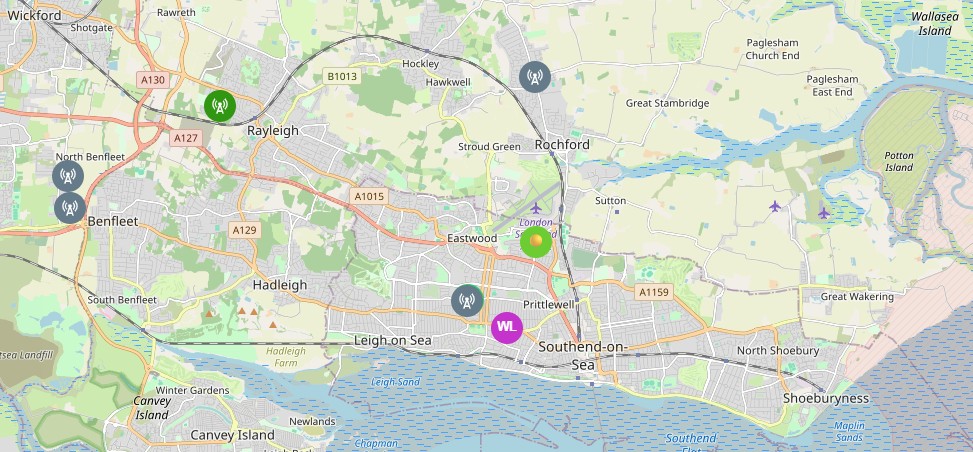
As a snapshot, here’s what Southend’s Meshcore network looks like (Source: Meshcore Map) – click for larger image:
More Info
Our nodes are located in Westcliff, labelled SXHamRpt (Repeater), SXHam01 (client) and SXHam02 (mobile) – see Essex Ham MeshCore. Hardware is a Heltech v3. A common place to look is AliExpress – See: Lora at AliExpress. The Heltec v3 is now available on Amazon: Heltec v3 at Amazon
Got a question or a comment? Add them below, or join the Essex Ham Meshcore and Meshtastic forum